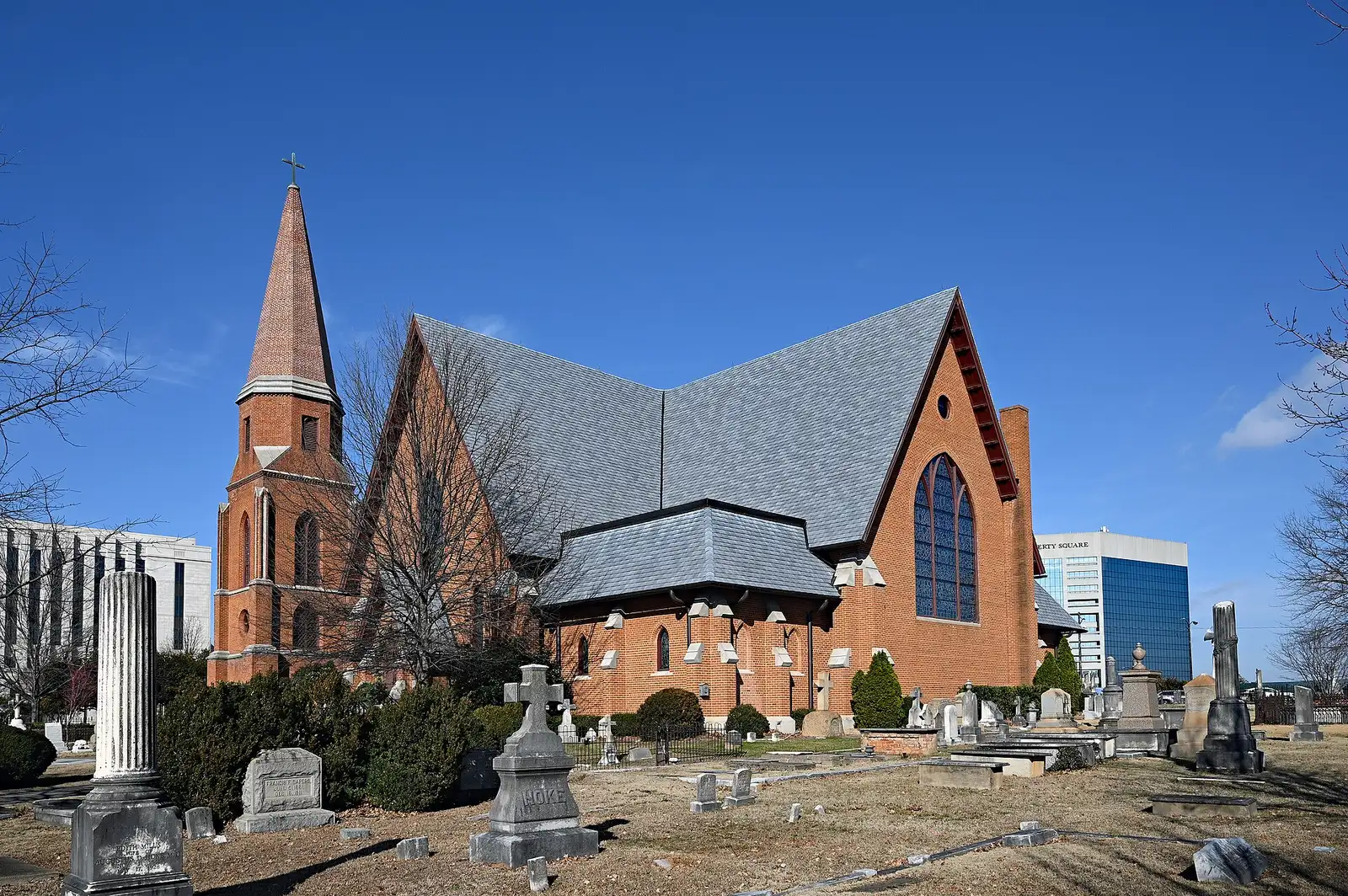
Greenville began as Pleasantburg in 1797, became a town in 1823 and a city in 1869. Here are its 55 National Register listings, museums and historic cemeteries.
Last checked Oct. 16, 2026. The timeline comes from the City of Greenville’s 175th anniversary historical timeline (PDF), compiled from city records by local historians. National Register listings come from the National Park Service’s National Register data, updated May 22, 2026. Greenville County Historical Society: 864-233-4103.
Greenville grew up around the falls of the Reedy River. An Irish-born trader, Richard Pearis, received a deed for land along the Reedy in 1769, and the 400 acres that became downtown were surveyed in 1784, the city’s timeline says. The village was laid out as Pleasantburg in 1797 and chartered as the Town of Greenville in 1823. It became a city in 1869.
Who to call
- Greenville County Historical Society: 644 E. Washington St., 864-233-4103, greenvillehistory.org
- Upcountry History Museum: 540 Buncombe St., 864-467-3100
- City cemeteries (Springwood, Richland): Greenville Cares, 864-232-2273; cemetery liaison 864-467-4091
Timeline
From the city’s historical timeline (PDF):
| Date | What happened |
|---|---|
| July 29, 1769 | Indian trader Richard Pearis receives a deed for about 12 square miles of land |
| May 21, 1784 | 400 acres including the Pearis site, now downtown, are surveyed for Thomas Brandon |
| March 22, 1786 | Greenville County is established as Greeneville, probably for Gen. Nathaniel Greene |
| May 23, 1788 | Lemuel James Alston buys 400 acres on both sides of the Reedy River |
| April 1, 1795 | A U.S. post office opens in Greenville Village |
| 1797 | The plat for the Village of Pleasantburg is recorded; the first lots, now the site of City Hall, are sold June 15 |
| Nov. 15, 1815 | Vardry McBee of Lincoln County, North Carolina, buys the Alston lands |
| Dec. 20, 1823 | The General Assembly charters the village as the Town of Greenville |
| Dec. 17, 1831 | The town is rechartered by the state legislature |
| Feb. 25, 1869 | The General Assembly amends the town charter to establish Greenville as a city |
| 1874 | The Greenville Daily News, the first daily newspaper in the city and county, begins publication |
After the Civil War, Greenville built a textile industry that was a world leader by the 20th century, and the rebirth of Reedy River Falls, now Falls Park, made the river the center of downtown life again, Mayor Knox White wrote in the city’s 175th anniversary booklet.
Historic districts
Greenville’s first National Register historic district was Hampton-Pinckney, listed in 1977 and extended in 1982. Others include the Col. Elias Earle Historic District (1982), the Pettigru Street Historic District (1982), the West End Commercial Historic District (1993) at the south end of Main Street, East Park (2005) and the Dunean Mill Historic District (2019).
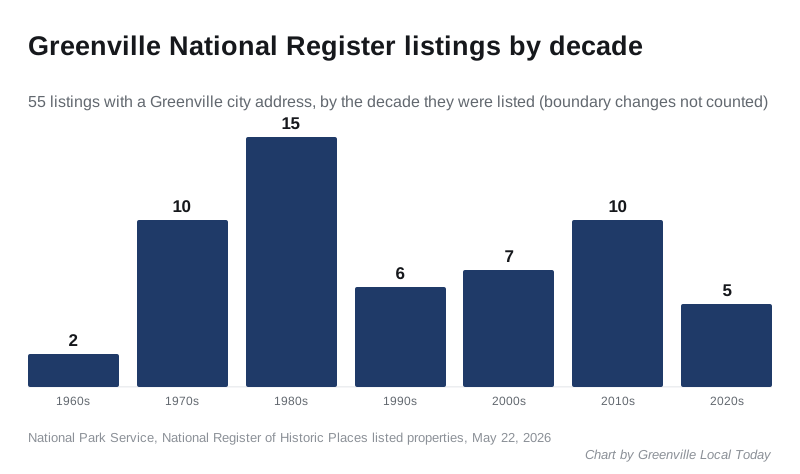
Chart: listings by decade
Every National Register listing in Greenville
The National Park Service lists 55 properties and districts with a Greenville city address. Most are privately owned and not open to the public. Boundary changes to the Reedy River Falls park (1978) and the West End district (1998) are not counted separately; McBride’s Office Supply, 832 Wade Hampton Blvd., had additional documentation accepted in 2024.
| Listing | Location | Listed |
|---|---|---|
| Earle Town House | 107 James St. | 1969 |
| Whitehall | 310 W. Earle St. | 1969 |
| Christ Church (Episcopal) and Churchyard | 10 N. Church St. | 1971 |
| Reedy River Falls Historic Park and Greenway | Both banks of the Reedy from the falls to Church Street | 1973 |
| Fountain Fox Beattie House | North Church Street | 1974 |
| Josiah Kilgore House | North Church and Academy streets | 1975 |
| Downtown Baptist Church | 101 W. McBee Ave. | 1977 |
| Hampton-Pinckney Historic District | Hampton Avenue and Pinckney Street | 1977 |
| John Wesley Methodist Episcopal Church | 101 E. Court St. | 1978 |
| William Bates House | East of Greenville on S.C. 14 | 1978 |
| Broad Margin | 9 W. Avondale Drive | 1978 |
| Reedy River Industrial District | Along the Reedy between River Street and Camperdown Way | 1979 |
| T.Q. Donaldson House | 412 Crescent Ave. | 1980 |
| American Cigar Factory | East Court Street | 1982 |
| Chamber of Commerce Building | 130 S. Main St. | 1982 |
| Davenport Apartments | 400-402 E. Washington St. | 1982 |
| Col. Elias Earle Historic District | Earle, James, North Main and Rutherford streets | 1982 |
| Greenville Gas and Electric Light Company | 211 E. Broad St. | 1982 |
| Hampton-Pinckney Historic District Extension | Hampton, Lloyd and Hudson streets, Butler and Asbury avenues | 1982 |
| Isaqueena | 106 DuPont Drive | 1982 |
| Lanneau-Norwood House | 417 Belmont Ave. | 1982 |
| Mills Mill | Mills and Guess streets | 1982 |
| Pettigru Street Historic District | Pettigru, Whitsett, Williams, Manly and nearby streets | 1982 |
| Poinsett Hotel | 120 S. Main St. | 1982 |
| Working Benevolent Temple and Professional Building | Broad and Fall streets | 1982 |
| Imperial Hotel | 201 W. Washington St. | 1985 |
| First National Bank | 102 S. Main St. | 1989 |
| West End Commercial Historic District | Pendleton, River, Augusta and South Main streets | 1993 |
| C. Granville Wyche House | 2900 Augusta Road | 1993 |
| Greenville County Courthouse | 130 S. Main St. | 1994 |
| Carolina Supply Company | 35 W. Court St. | 1997 |
| Paris Mountain State Park Historic District | 2401 State Park Road | 1998 |
| Brushy Creek | 327 Rice St. | 1999 |
| Hugh Aiken House | 1 Parkside Drive | 2003 |
| Gilfillin and Houston Building | 217-219 E. Washington St. | 2004 |
| East Park Historic District | East Park Avenue, Bennett Street, Harcourt Drive and Rowley Street | 2005 |
| Monaghan Mill | 201 Smythe St. | 2005 |
| Richland Cemetery | Hilly and Sunflower streets | 2005 |
| Springwood Cemetery | Main and Elford streets | 2005 |
| Stradley and Barr Dry Goods Store | 14 S. Main St. | 2008 |
| Allen Temple A.M.E. Church | 109 Green Ave. | 2010 |
| E.W. Montgomery Cotton Warehouse | 806 Green Ave. | 2012 |
| U.S. Post Office and Courthouse | 300 E. Washington St. | 2014 |
| Brandon Mill | 25 Draper St. | 2014 |
| Greenville Elks Lodge | 18 E. North St. | 2015 |
| Beth Israel Synagogue | 307 Townes St. | 2016 |
| William and Harriet Wilkins House | 105 Mills Ave. | 2016 |
| American Spinning Company Mill No. 2 | 300 Hammett St. | 2016 |
| Judson Mill | 701 Easley Bridge Road | 2018 |
| Dunean Mill Historic District | Madden, Allen, Whitten and Hutchins streets | 2019 |
| Poe Hardware and Supply Company | 556 Perry Ave. | 2021 |
| Triangle Building | 1203-1211 Pendleton St. | 2022 |
| Greenville Pepsi-Cola Bottling Plant | 705 Poinsett Highway | 2023 |
| Borden Ice Cream Factory | 711 W. Washington St. | 2023 |
| St. Andrew’s Episcopal Church | 1002 S. Main St. | 2025 |
Museums and places to visit
- Upcountry History Museum, 540 Buncombe St. Open 10 a.m. to 5 p.m. Tuesday through Saturday and 1 to 5 p.m. Sunday; 864-467-3100. Its exhibit on the Upstate during the American Revolution runs through Oct. 24, 2027.
- Greenville County Museum of Art, 420 College St. Open 11 a.m. to 5 p.m. Friday, 10 a.m. to 5 p.m. Saturday and 1 to 5 p.m. Sunday; closed Monday through Thursday; 864-271-7570.
- Greenville County Historical Society, 644 E. Washington St., holds free lectures at 6:30 p.m. on the third Wednesday of each month, September through May, at Downtown Presbyterian Church, 435 W. Washington St.; the next is Oct. 21, the society says.
- Springwood Cemetery, 410 N. Main St., and Richland Cemetery, 7 Fern St., are city cemeteries, both on the National Register since 2005.
What this means for you
- Most listed homes are private; enjoy them from the sidewalk.
- Hampton-Pinckney and Pettigru Street are easy walks from Main Street.
- The Upcountry History Museum and the historical society’s free monthly lectures cover the region’s story from the Revolution on.
More: parks and trails, population and growth and getting around Greenville.
Frequently asked questions
When was Greenville, SC, founded?
The plat for the Village of Pleasantburg was recorded in 1797. The General Assembly chartered it as the Town of Greenville on Dec. 20, 1823, and amended the charter to make Greenville a city on Feb. 25, 1869, according to the city’s historical timeline.
What was Greenville, SC, originally called?
Pleasantburg. The village plat was recorded under that name in 1797; the county itself was established in 1786 as Greeneville, probably in honor of Gen. Nathaniel Greene.
How many National Register sites are in Greenville, SC?
The National Park Service lists 55 properties and districts with a Greenville city address, from the Earle Town House and Whitehall in 1969 to St. Andrew’s Episcopal Church in 2025.
What are the Upcountry History Museum’s hours?
10 a.m. to 5 p.m. Tuesday through Saturday and 1 to 5 p.m. Sunday, at 540 Buncombe St. Call 864-467-3100.
Have your say